


Introduction
Artificial Intelligence has become one of the most discussed business topics of the decade.
Every day, businesses are exposed to headlines about automation, AI assistants, machine learning, predictive analytics, and intelligent customer experiences. The pressure to “adopt AI” has never been greater.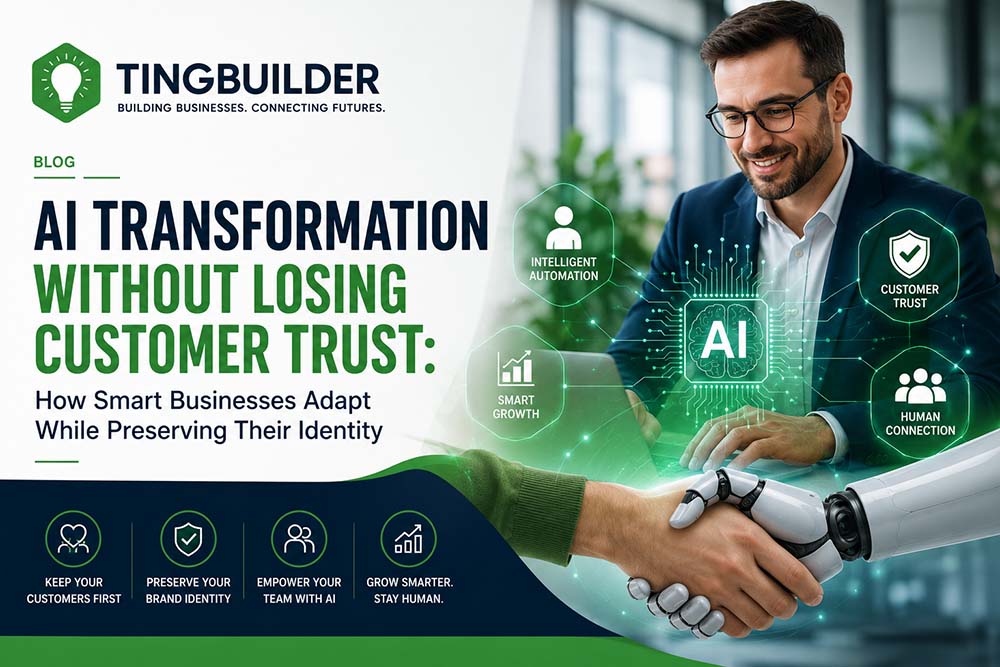
However, many business leaders face a legitimate concern:
How do we embrace AI without losing the trust, reputation, and customer relationships we have spent years building?
The answer is simple.
Successful businesses do not adopt AI to replace their identity.
They adopt AI to strengthen it.
The companies that will thrive in the coming years are not the ones blindly following trends. They are the ones strategically leveraging technology to deliver greater value while preserving the qualities customers already trust.
AI Should Enhance Your Business, Not Redefine It
Many organizations make the mistake of approaching AI as a complete transformation of their business model.
Customers rarely care whether a company uses AI.
Customers care about:
- Faster service
- Better experiences
- Accurate information
- Reliability
- Convenience
- Consistency
- Trust
AI should remain largely invisible to customers. Its purpose is not to become the center of attention. Its purpose is to make the business perform better.
The best AI implementations often go unnoticed because customers simply experience a smoother, more efficient service.
Avoiding the “Trend Follower” Perception
Customers can quickly recognize when businesses chase trends without a clear purpose.
Examples include:
- Replacing all human interaction with chatbots
- Introducing AI features nobody requested
- Overusing AI marketing buzzwords
- Implementing automation that reduces service quality
- Prioritizing efficiency over customer relationships
These approaches often create the impression that a company is following hype rather than focusing on customer value.
Strong businesses take a different approach. They evaluate technology based on one question:
Will this improve the customer experience?
If the answer is yes, adoption makes sense.
If not, the technology can wait.
The Most Successful AI Is Often Invisible
Customers do not necessarily want more AI. They want better outcomes.
Consider the following examples:
- Faster Customer Responses : AI helps teams draft responses quickly while humans maintain oversight and personalization.
- Better Support Experiences : AI assists support teams by retrieving information faster, allowing customers to receive accurate answers more quickly.
- Improved Service Delivery : Automation reduces delays, paperwork, and repetitive tasks.
- Personalized Experiences : AI helps businesses understand customer preferences and provide more relevant recommendations.
In each case, customers experience improved service without feeling disconnected from the business.
Protecting the Human Element
One of the greatest assets any business possesses is human trust.
Relationships, expertise, empathy, and understanding cannot simply be automated away. Businesses should identify areas where human interaction creates value and preserve them.
Examples include:
- Consultations
- Strategic discussions
- Customer relationship management
- Complex problem solving
- Personalized recommendations
- High-value support interactions
AI should handle repetitive work so people can focus on higher-value interactions.
The goal is not fewer human connections.
The goal is better human connections.
AI as a Tool, Not a Replacement
Throughout history, businesses have adopted tools that improved productivity.
- Computers did not replace businesses.
- The internet did not replace businesses.
- Cloud software did not replace businesses.
- They enhanced the way businesses operate.
- AI should be viewed in exactly the same way.
It is another tool that allows teams to:
- Work faster
- Make better decisions
- Reduce repetitive tasks
- Improve consistency
- Scale operations efficiently
The business itself remains unchanged.
Its mission, values, expertise, and customer relationships continue to define its identity.
A Gradual and Strategic Approach to AI Adoption
The most effective AI transformations are rarely dramatic. They happen through a series of small improvements.
A practical adoption strategy often includes:
- Phase 1: Internal Productivity : Improve employee efficiency before introducing customer-facing AI.
- Phase 2: Process Automation : Automate repetitive administrative tasks and workflows.
- Phase 3: Data and Insights : Use AI to identify patterns, opportunities, and business intelligence.
- Phase 4: Customer Experience Enhancements : Introduce carefully selected customer-facing improvements.
This gradual approach reduces risk while maintaining service quality.
Building Customer Confidence During Transformation
Customers are generally supportive of innovation when it clearly benefits them.
Businesses can strengthen confidence by:
- Maintaining transparency
- Preserving service quality
- Keeping human support available
- Communicating improvements clearly
- Prioritizing customer outcomes over technology
The focus should always remain on value rather than novelty.
Customers are not impressed because a business uses AI. Customers are impressed when a business serves them better.
The Competitive Advantage of Adaptability
The most respected companies are rarely the first to adopt every new technology.They are the ones that evaluate innovations carefully and implement them effectively.
Adaptability is becoming one of the most important business strengths in 2026. Businesses that resist all change risk falling behind.
Businesses that chase every trend risk losing focus. The strongest position lies in the middle.
A business that remains grounded in its values while continuously improving through technology becomes both stable and adaptable.
This creates long-term resilience and competitive advantage.
Technology Should Support the Brand, Not Become the Brand
Customers build relationships with businesses because of:
- Trust
- Reliability
- Expertise
- Quality
- Service
Technology should amplify these qualities.
A customer should think:
“This company is easier to work with.”
Not:
“This company is trying to impress me with AI.”
The most successful digital transformations happen when technology quietly strengthens the customer experience while allowing the company’s personality and values to remain at the forefront.
Final Thoughts
AI is not a destination. It is a tool. Businesses should not measure success by how much AI they deploy. They should measure success by the value they create for customers.
Organizations that approach AI strategically can improve efficiency, enhance service quality, empower employees, and strengthen customer relationships without compromising the trust they have built over many years.
The future belongs neither to businesses that resist change nor to those that blindly chase trends.
The future belongs to businesses that adapt intelligently, preserve their identity, and use technology to create meaningful value for the people they serve.
About TingBuilder
At TingBuilder, we believe technology should enhance businesses, not redefine them.
Our approach focuses on practical digital transformation, strategic AI adoption, automation, software solutions, and technology guidance that aligns with business goals while protecting the trust and reputation organizations have built over time.
Technology is most powerful when it works quietly in the background, allowing businesses to focus on delivering exceptional value to their customers.